
Having the right brain to lead your business into the future


Twenty years ago, this year Daniel H. Pink’s book “A Whole New Mind: Why Right-Brainers will rule the future” was published. The book challenged the traditional notion of success by emphasising the importance of ‘right-brain’ qualities such as inventiveness, empathy, and meaning in the modern world. Pink argued that the era of ‘left-brain’ dominance was fading, making room for a new world, where qualities traditionally associated with the ‘right-brain’ were becoming more valuable. He argued that in future personal, professional, and business success would require leaders moving beyond fostering ‘left-brain’ qualities such as logic and linear thinking, critical for analysis and problem-solving to developing six ‘right-brain’ high concept, high touch “senses”: Design, Story, Symphony, Play, Empathy, and Meaning.

According to Pink, individuals and organisations developing these senses would be better able to adapt and thrive in an increasingly complex and fast-changing world.
Twenty years on, the future that Pink was referring to is here now. The speed of technological advancements being made means that leaders need to foster these skills to thrive.
Is the world really changing now as suggested by Pink?
There is considerable evidence that Pink was on the right track with his predictions twenty years ago. Here are a few examples:
According to the British Council 65% of primary school students will be employed in jobs that don’t yet exist.
According to the World Economic Forum’s Future of Jobs Report 2023 two-fifths of the core skills workers have today will be disrupted by technological change by 2027. Half of all workers’ core skills will need to be updated every five years.
A 2017 report “The next era of human machine partnerships” by Dell Technologies and the Institute for the Future (IFTF) suggests that every organisation will need to become a technology organisation to future-proof their infrastructure and workforce. The report goes on to say that technologies like artificial intelligence, robotics, virtual reality, and cloud computing will radically alter society and work dynamics Continuous skill development will be needed to adapt to evolving job requirements. A future is envisioned where humans collaborate with technology, combining human skills like creativity and passion with machine capabilities in speed and automation to drive productivity and innovation.
McKinsey in 2022 urged organisations to embrace the rise of machines (automation and AI) rather than fearing it.
Max Tegmark’s book “Life 3.0: Being Human in the Age of Artificial Intelligence” emphasises the ethical imperative of AI safety research, and the development of ‘friendly’ AIs that assist human endeavours. Leaders must therefore understand AI technology and engage with its ethical dimensions to ensure that AI developments benefit society as a whole.
“The Future Is Faster Than You Think: How Converging Technologies Are Transforming Business, Industries, and Our Lives” by Diamandis and Kotler highlights the convergence of exponential technologies leading to rapid societal and industrial transformations. Digital currencies and blockchain technology will facilitate money and finance becoming increasingly decentralised and personalised. Diamandis suggests that leaders must be agile and adaptable, to be capable of steering their organisations through the accelerating pace of change.
A 2024 report by Accenture “Work, workforce, workers: Reinvented in the age of generative AI” stresses that leaders need to embrace new ways of learning and leading to harness the potential of AI. The report highlights the disparity between workers’ enthusiasm for working with AI and their concerns about job loss and burnout, revealing a trust gap between employees and business leaders. To succeed in implementing AI, leaders must ensure that work is designed to benefit everyone, with a focus on upskilling employees and fostering a culture of continuous learning. People-centric approaches, such as engaging employees to address concerns and build trust, will be crucial for leaders to adopt. The report emphasises the importance of upskilling employees to adapt to this technological shift, highlighting the need for continuous learning and development of both technical and meta skills such as creativity and problem-solving. As organisations grapple with integrating AI technologies into their operations, leaders are tasked with fostering a culture that prioritises trust, engagement, and innovation to successfully navigate this transition.
“A Whole New Mind”
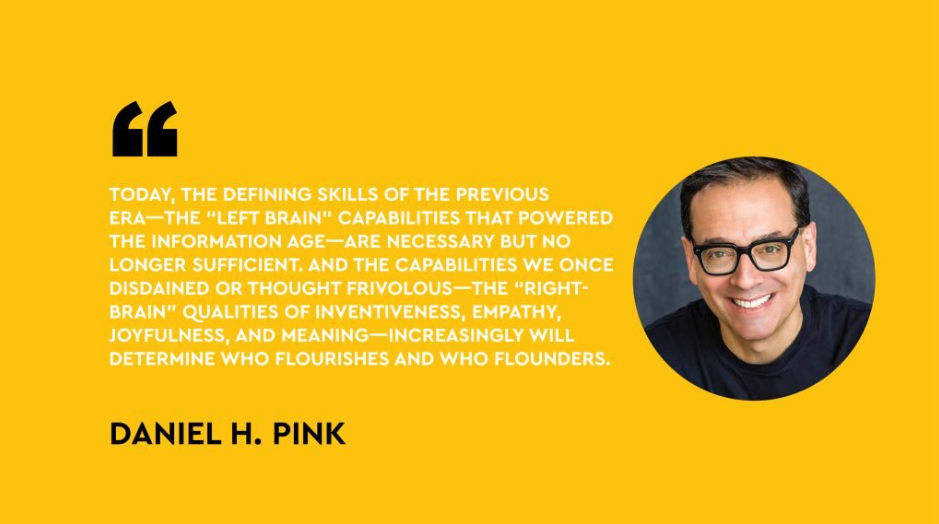
In order to succeed in this new world, we need to approach the challenges and opportunities that disruptive tech presents with a whole new mindset. Pink posited that ‘right-brain’ qualities such as design, story, symphony, empathy, play, and meaning would be crucial in the future and we think that he was right. So, let’s take a closer look at each of the six senses from a leadership perspective.
Design: Leaders will need the ability to create beautiful disruptive tech fuelled products and services and have the design sense to know how these products and services should look, feel, and function in future.
Story: Leaders will need the ability to use story to engage, inform, motivate, and inspire others to boldly go into the disruptive tech era.
Symphony: Leaders will need the ability to see the big picture and understand how disruptive tech can create a whole new business where everybody wins.
Empathy: Leaders will need the ability to deeply understand, connect and relate to others about their thoughts and feelings around tech disruption.
Play: Leaders will need the ability to create fun, experimental, safe, humorous ways to play with disruptive tech.
Meaning: Leaders will need the ability to create purpose, meaning and fulfilment on the disruptive tech journey.
Today’s leaders need to foster these skills to inspire innovation and maintain a human-centric approach amidst technological advancements.
So, how can you develop your ‘right-brain’?
There are several practices that can help get your ‘right-brain’ juices flowing.
Engage in creative activities e.g. pottery, painting, storytelling, dance.
Take on new challenges, learning from mentors.
Foster a culture of creativity, collaboration, experimentation, and innovation within your organisation.
Check out Julia Cameron’s “The Artists Way” to support your creative journey.
Doodle or sketch ideas.
Practice telling stories with family, friends, and colleagues.
Take up journalling.
Start your day with something creative.
Surround yourself with diverse thinkers and creative types.
Explore something new each day or week: music, film, art, books, food, theatre, visit somewhere different, take a new route to work.
Pause every so often at work to consider the big picture.
Simply play with a fidget or a sensory gadget – they help to enhance focus and boost creativity.
Conclusion
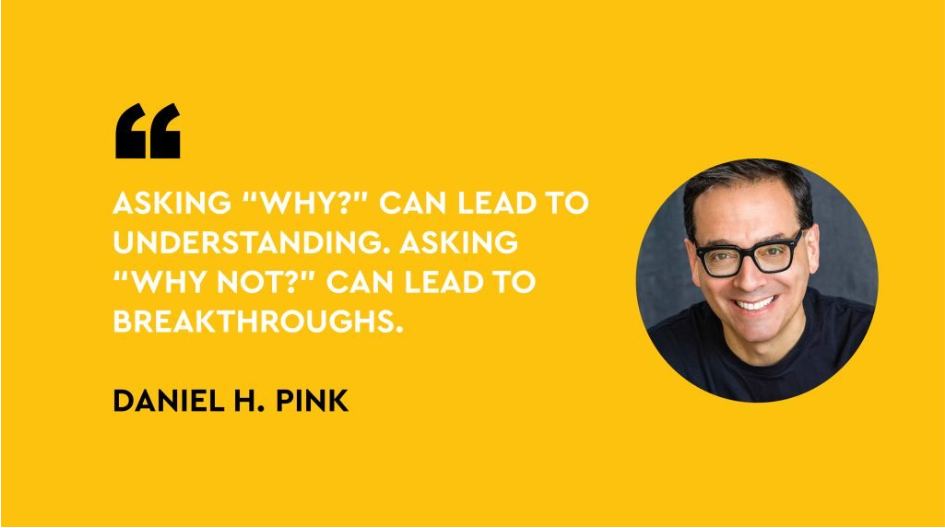
Future leaders in the financial services sector need to embody a blend of technological proficiency, ethical consideration, ‘right-brain’ creativity, and an inclusive leadership style. As disruptive technologies continue to redefine our sector as well as our lives, leaders who can harmonise these elements will be best positioned to succeed in the dynamic landscape ahead.
Questions for you
Which of the senses Design, Story, Symphony, Play, Empathy, and Meaning do you need to polish? How will you develop those sense(s)? Remember to have fun. 😉
Daniel Pink: A Whole New Life
“People who are intrinsically motivated they do just fine.”
If you have an hour to spare and enjoyed the snippet, here is the full video 😉


Comments