
Why celebrating success at work matters
- RIE Solutions

- May 14
- 7 min read

For most ops leaders, there is rarely a quiet stretch. Deadlines flow into the next set of pressures. Regulatory updates, audit cycles, team challenges, system changes, and lots of expectations. It can feel like the work is never quite finished, only moved forward.
In that environment, it is easy to keep going without pausing to notice progress. But celebration is not an optional extra. It’s part of how sustainable performance is built.
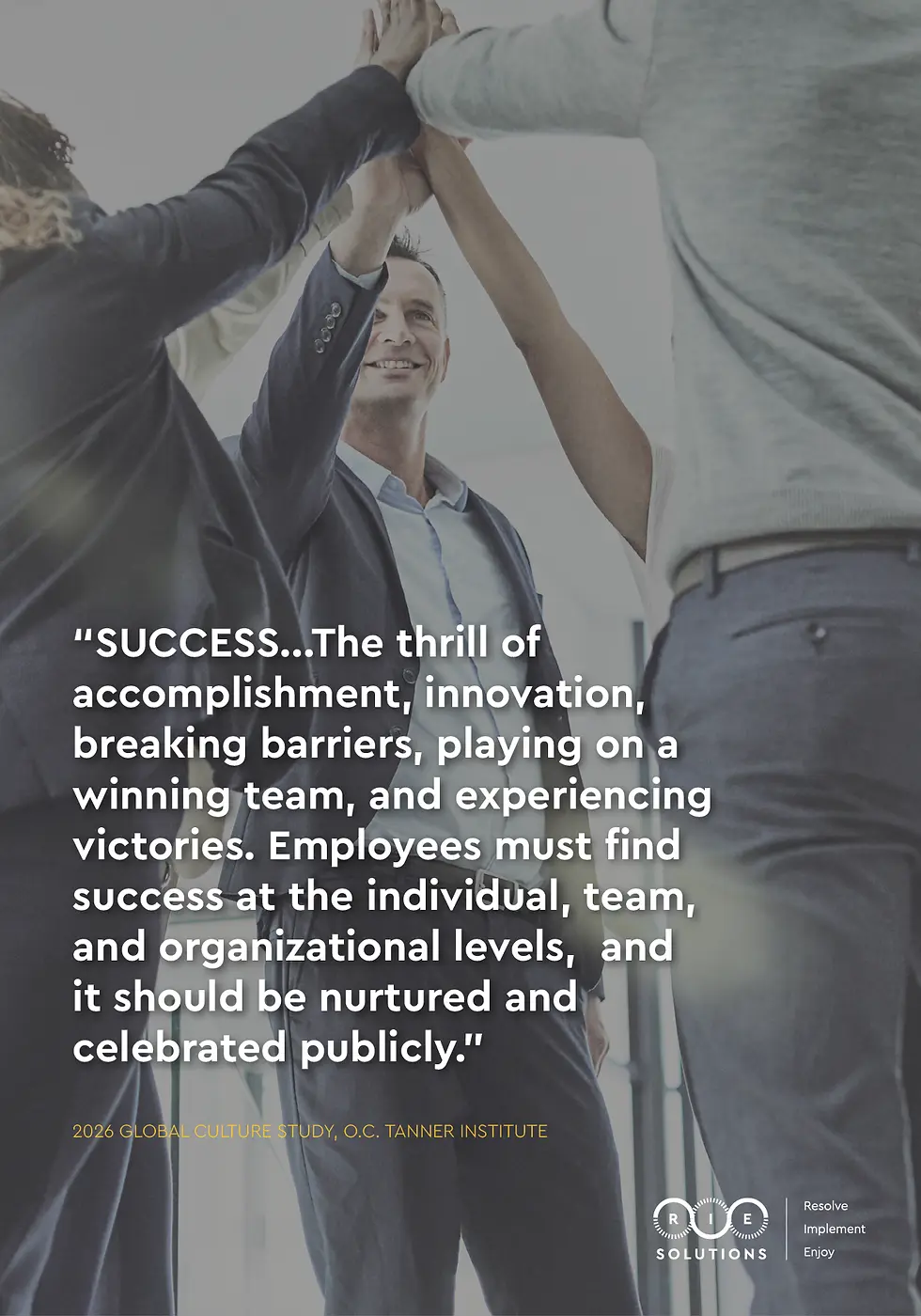
Recognising success is one of the simplest ways to make good work visible, strengthen your culture, and help people stay energised in roles that carry real responsibility.
What celebrating success actually does
When recognition is done well, it has very practical impact on how teams operate, beyond an improved culture and a boost of positivity.
First, it creates clarity.
When you say, “This is a win, and here is why”, you are not just acknowledging effort. You are defining what good looks like. You are highlighting the standards that matter in your organisation. Over time, your team learns what excellence means in practice, whether that is a great client outcome, thoughtful judgement, strong collaboration, or disciplined process execution.
Second, it strengthens psychological safety.
In many operational environments, people are naturally cautious. If the only feedback they hear focuses on what went wrong, they learn to stay quiet and avoid risk taking. When you actively recognise good judgement, early escalation, and thoughtful challenge, you send a different message. You show that speaking up is valued and encouraged. That is critical in environments where preventing issues early is part of the role.
Third, it improves how work flows.
Teams that feel seen behave differently. They tend to collaborate more openly, raise risks earlier, and take greater ownership. The result is not abstract. It shows up in smoother handovers, fewer unnecessary loops, and better cross team coordination.
What happens when recognition is missing
Without intentional celebration, a default culture often takes hold.
Work becomes something that is simply expected. Progress is rarely acknowledged. Mistakes receive attention, while good work passes quietly in the background.
Over time, this creates imbalance.
People begin to narrow their focus to what is strictly required. Initiative becomes less frequent. Ideas are held back. High performers, in particular, can become disengaged when their contribution feels invisible.
There is also an operational impact. Teams may become more cautious, focusing on avoiding blame rather than improvements and innovation. This can slow down change, reduce momentum, and make transformation work harder than it needs to be.
In short, the absence of recognition does not create neutrality. It shapes behaviour in ways that are often unhelpful.

The case for celebration
There is a growing body of evidence that links recognition to wellbeing, engagement, and performance. While the terminology may vary, the underlying insight is consistent. How people feel at work influences how they show up, and that in turn affects results.
In practice, recognition works best when it is simple, consistent, and genuine.
It doesn’t need to involve large gestures or formal programmes. Small moments of acknowledgement, when done well, can have meaningful impact. A timely thank you. A clear explanation of why something mattered. A brief moment in a meeting where good work is named and appreciated.
The key is not scale. It is intention.

Making celebration work in practice
The most effective recognition tends to follow a few simple principles.
✅Be timely.
Acknowledge the success close to when it happens. This helps people connect the behaviour with the outcome.
✅Be specific.
Name what was done well and why it mattered. “Thank you” isn’t enough. “Thank you for the way you handled that client issue, it prevented risk and reassured the client” carries much more weight.
✅Be fair.
Ensure recognition is spread across the team. Notice different types of contribution, including the quieter, behind the scenes work that keeps operations running smoothly.
✅Be purposeful.
Link recognition back to what matters: client outcomes, team collaboration, company values or goals. This reinforces why the work is important.
When these elements are present, recognition feels authentic and useful. When they are missing, it can feel vague or uneven, which quickly loses impact.
A simple way to embed it
Rather than adding something new, it often works best to build celebration into what already exists.
One simple approach is to introduce a short reflection at the start of a regular team meeting.
A “win and why it mattered” round can take just a couple of minutes. The focus is not on listing achievements, but on highlighting behaviours and impact. Over time, this creates a rhythm where good work is regularly noticed and discussed.
As a leader, your role is to guide what gets recognised. Look beyond the most visible outcomes. Pay attention to effort that protects the business, improves quality, or supports others. This is often where the real value sits.
You can also encourage peer recognition. When appreciation flows only from the top, it can feel formal. When team members recognise each other, it becomes part of how the team operates day-to-day.
Addressing the hesitation
Many professionals feel slightly uncomfortable with the idea of celebrating success. There can be a concern that it might come across as self-promotion or unnecessary attention.
In practice, celebration doesn’t need to focus on individuals in a way that feels uncomfortable. It can focus on the work, the learning, and the collective effort.
Sharing what went well and why is not about showing off. It is about reinforcing what works and building shared understanding.
It also creates a feedback loop. When success is made visible, it becomes easier to learn from it. Teams can see what to repeat, what to refine, and where to build further capability.
Seen in this way, celebration is not separate from performance management. It is part of doing it well.
Celebrate progress, not perfection
One of the most important shifts is to focus on progress.
In operational roles, not every piece of work will be perfect. Waiting for flawless outcomes before recognising success means many valuable contributions will be overlooked.
Instead, notice progress. A smoother process. A well-handled situation. A step forward in how the team works together. These moments build long term capability.
Recognising them helps maintain momentum and encourages
A final thought
Celebrating success is ultimately about paying attention.
In busy environments, it is easy to focus only on what needs fixing. But what you choose to notice shapes your culture just as much as what you challenge.
When you make space to recognise good work, you create clarity about what matters. You strengthen confidence in your team’s judgement and you build the energy that carries people through the next phase of work.
If you try one thing this week, keep it simple.
Pause in your next team conversation. Highlight one piece of work that made a difference. Be clear about why it mattered. Make sure it is something that might otherwise have gone unnoticed.
Then do it again next week.
Over time, these small, consistent moments of recognition become part of how your team sees itself. And that is where the real impact sits.
Reference:
O.C. Tanner Institute. Inspire 2026 Global Culture Report
“Finally, remember every workplace culture is fluid and evolving. Even the best ones are testing, learning, and adapting. Progress, not perfection, is the goal, and every step that elevates the employee experience is progress.”
✨ THE PROGRESS PRINCIPLE | TERESA AMABILE✨
“Of all the events that can deeply engage people in their work, the single most important is simply making progress on meaningful work.”
🚀 THROWBACK THURSDAY 🚀
DOES YOUR FIRM PLAY A TEAM SPORT?

The best teams, on the pitch and in business, don’t win by chance. They succeed because they share a clear goal, trust one another, and treat setbacks as fuel for growth rather than failure. Argentina’s World Cup win is a powerful reminder: when individuals put the team first, communicate openly, and learn from mistakes, extraordinary results follow. The same applies inside firms. Clear vision, psychological safety, accountability, and celebrating progress are what turn “working together” into winning together. Teamwork isn’t soft, it’s strategic. And when done well, it becomes your biggest competitive advantage. Interested? Read our blog here to remember the full story. 📢OPS JOB BOARD📢If you have an opening for a Practice Managers, Operations Director, Business Manager, Head of Operations, or an Ops Assistant, you can register your opportunity on our Job Board for FREE! 🤩 Just drop us a line atinfo@rie.solutions! We’d love to hear from you. |
UPCOMING EVENTS📢Ops call: Admin capacity. Is it really a resourcing issue, or a different problem? 📢Join us on Tuesday, 19 May at 2:00pm GMT (MPC members only) for a practical session facilitated by Dominika, where you’ll explore: · How you structure admin roles today? · Where pressure shows up most often? · Testing whether capacity issues are real or perceived? · What can/has help(ed) smooth peaks and improve flow of work? · What data, if any, supports your resourcing conversations? 🚀Ops webinar: Values Driven Operations-From Posters to Practice with Dominika Sieradzka-MacCuirc🚀Join us on Tuesday, 2 June at 10:00am GMT (MPC members only) for a session that explores what Values Driven Operations means and how to bring it to life in a way that’s practical, sustainable, and genuinely meaningful. 📢Ops clinic with Dominika Sieradzka-MacCuirc📢Join us on Tuesday, 9 June at 10:00am GMT (MPC members only) for one of our regular Ops Clinics with Dominika. This is the perfect opportunity for you to ask questions, get advice on projects you’re working on, or, share challenges you’re facing right now. 🤓 ‘A problem shared is a problem halved’ or even better, solved!💡 Let’s tackle these ops challenges together! 🤗 ✨🤖Demo: Centology with David Stamp & Joe Power 🤖✨Join us on Thursday, 16 June at 2:00pm GMT (MPC members and their team members only) for a fresh look and a live demo of Centology with David Stamp, Chief Executive Officer and Financial Adviser & Joe Power Chief Operating Officer. We explored Centology a few years ago, and since then the product and its propositions have moved on. This session is a chance to see what’s changed and how it now supports financial planning firms in practice 🔍 If you are not a member of the Master Practitioners Club already why not consider joining us now! Together we can achieve so much more! 🙌 🔧 THE OPS EDGE 🔧
Celebrate progress, not just outcomes.Build in regular checkpoints into your ops rhythm where teams share what’s moved forward, not only what’s finished. Momentum, clarity, and trust grow when progress is visible and performance follows. |


Comments