
The Art of Storytelling
- RIE Solutions

- Jan 29
- 5 min read

Last month’s blog challenged you to harness right-brain thinking and promoted storytelling amongst other things as a path to professional success and personal fulfilment. Seth Godin’s book “Purple Cow” pushes you even further and encourages you to be remarkable, to create financial products, services, and businesses that stand out, much like a story that captivates an audience.
Storytelling is a powerful tool for transformation, shaping of perceptions, influencing decisions, promoting your business, and forging deeper connections. Telling a good story isn’t about facts or numbers; it’s about the human experiences behind them. So, what’s your business story? Is it compelling? Does your story encourage people to do business with you? Does it inspire your teams to achieve great things?
It’s not about the stories you tell, but how well you tell your stories
Having the ability to turn complex concepts into relatable stories or to craft compelling narratives to articulate a vision and inspire action defines some of the greatest leaders of all times. It’s often not the best idea but the best told story that ‘wins’! So, if you ever wonder why someone else is far more successful than you despite having a weaker proposition, you may find that it’s about the story they tell. The good news is that storytelling is a skill and like most skills it can be acquired! Master storytellers, such as Andrew Linderman or Helen Kuyper specialise in working with businesses to get their stories right, so fear not if this isn’t your strength.
Here is a simple storytelling formula that you can practice to get you started. According to the Chinese, a great story has the head of a tiger, the body of a pig, and the tail of a phoenix. Start with a roar to grab your audience’s attention (the head of a tiger). Once you have their attention, tell them something meaty, memorable, and worth their undivided focus (the body of a pig). Finally, finish your story with a flourish that inspires your audience into action (the tail of a phoenix). Why not try it next time you need to get something important across?

Telling the right stories
So, now you know how to tell a great story, but, is it the right story? Rob Biesenbach’s book “Unleash the Power of Storytelling” provides a practical framework for business professionals to craft stories that resonate with their audience and deliver the desired outcomes. Crafting a story creates the ‘right message’, for your perfect audience, to achieve the desired purpose. The storyteller must also be the ‘right person’ to communicate the story to that specific audience.
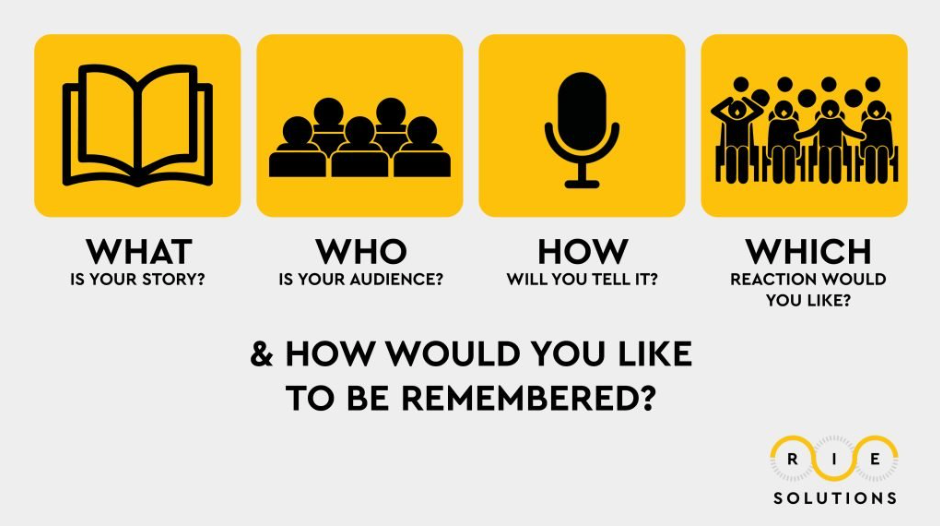
A good way of ensuring that you tell ‘the right story’ is to ask yourself the following five questions:
What’s your story?
Who’s your audience?
How’ll you tell your story?
What sort of a reaction would you like to evoke?
How would you like to be remembered?
If you are looking for more tips, you may want to read Akash Karia’s “TED Talks Storytelling”, which distils the essence of impactful storytelling into 23 storytelling techniques aimed to turn mundane presentations into memorable ones.
Tools such as, story boards (Disney), the story circle (Dan Harmon), the story field/matrix (Kuyper) all show the importance of structuring a story and provide ideas on how to go about it.
Why Stories?
Helen Kuyper produced a great list of the many ways in which stories have an impact on organisations. Her top 7 reasons for why storytelling is important are:
1) Stories inspire us to take action
Our emotions inspire us to act. Facts are not the truth, meaning is! A well-told story combines the power of emotion with relevant facts.
2) Stories can change people’s behaviour
The best way to change a person’s behaviour is to give them a new experience, create a different reality. It doesn’t matter to their body if the experience is real or a great story. In both instances the body responds in the same way. The story activates the imagination to simulate a real experience. So, a well-told story can have as much impact as a real-life experience.
3) Stories make your message stick
Your brain is not wired for data and information, it’s wired for stories. Stories are the gluethat holds all the information in your brain together. A great story not only captivates your audience but is more memorable. Indeed, Prof Jennifer Aaker of Stanford Graduate School of Business, states that “Stories are remembered up to 22 times more than facts alone”.
4) Stories turn strategy into action

Venture Capitalist and author Ben Horowitz says, ‘A company without a story is usually a company without a strategy’. A strategy without a story is useless to your business, because it doesn’t translate into concrete actions. If you want people to act, they have to have ownership of their story and they have to be part of the story. If people don’t feel part of the story, they don’t feel part of the business. So, an effective strategy needs to be built on a collective narrative.
5) Culture is defined by story
“Culture eats strategy for breakfast”. Stories can be more powerful than the truth. People don’t necessarily believe something just because it’s true. Your business culture is defined not by its strategy but by the stories you tell and the stories told about you and your business. What stories should you tell about your business?
6) Stories help you to find out what’s really going on
When you ask for facts, that’s what you get, facts. Facts are limited in what they can tell. Your business stories, both the stories about your business, as well as the stories told within, will tell you much more. If you want to find out what’s really going on in your business, let people tell you their stories.
7) Stories can be easily shared
With so much competition for people’s attention, being able to share something effectively within or outside your business is priceless. But first, you need to craft what you want to share, your stories. Only then can you determine the best ways to share your stories. Story first, then the telling.
When it comes to attracting attention, making your message stick, or changing people’s behaviours, attitudes and actions, a well-crafted, authentic story can make all the difference. Weave stories that inform and inspire as they are bridgesbetween information and emotion, logic and imagination, strategy and culture.
Finally, here are a few resources to help you tell your story:
HARNASSING THE POWER OF STORIES – PROF JENNIFER AAKER OF STANFORD GRADUATE SCHOOL OF BUSINESS
“Stories are remembered up to 22 times more than facts alone”


Comments