
Amazon’s Edge: Why the Constants Matter Most


What is your business strategy for coping with change?
Jeff Bezos once reframed the classic strategy question from “What will change?” to “What will not change?”. He built Amazon by doubling down on what customers would always value.
That same pivot is powerful in any sector, including financial planning. When you design your service propositions, processes, tech stack, and culture around enduring client needs, you create both resilience and focus allowing your business to thrive even as everything else shifts.
Reflection: So, what won’t change, for your clients, in the next 10 years?
What did Jeff Bezos believe would never change for Amazon’s customers?
Bezos’s answer was refreshingly simple and strategically powerful. He focused on three enduring customer needs that guided Amazon’s investments and fuelled its growth.
Bezos’s Immutable Customer Needs
Low Prices
Customers will never say, “I wish Amazon’s prices were higher.” Price sensitivity is a constant, so Amazon relentlessly invests in cost-efficiency and scale to keep prices down.
Fast Delivery
Speed matters. Bezos noted that no customer would ever ask for slower shipping. This insight drove Amazon’s massive investment in logistics, fulfillment centers, and Amazon Prime delivery (and I think that it’s safe to say that we all love that!).
Vast Selection
People want choice. Whether it’s books, electronics, or groceries, customers value having a wide array of options. Bezos knew this would remain true, so Amazon expanded its marketplace and product categories accordingly.
Bezos knew that because these needs are stable, Amazon could confidently build long-term strategies around them.
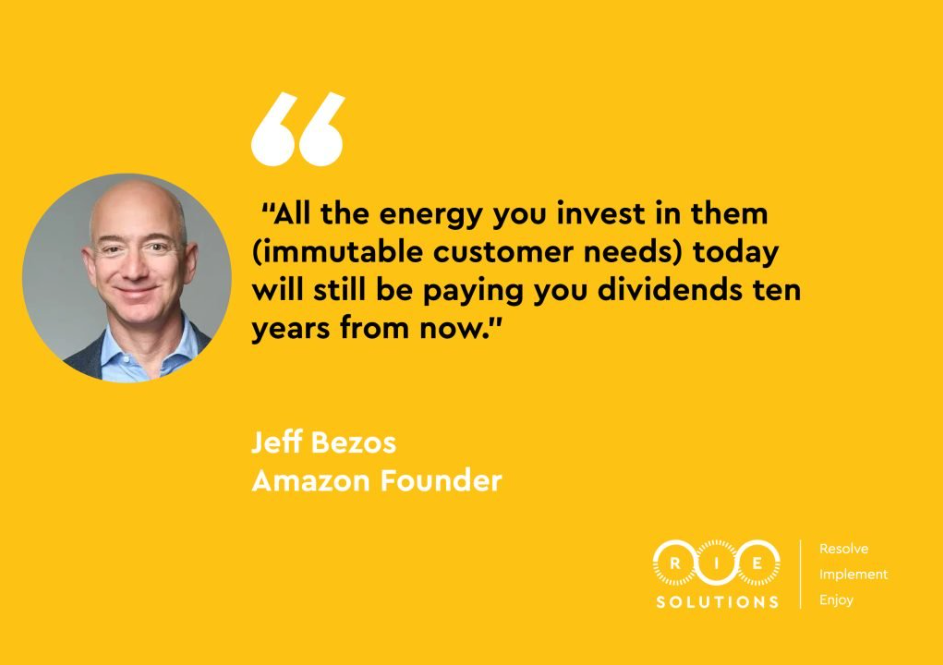
This principle became a cornerstone of Amazon’s flywheel model, anchored not in chasing what might change, but in doubling down on what customers will always want.
While many competitors pursued trends, Bezos centered Amazon’s strategy on three timeless customer desires: low prices, fast delivery, and vast selection. These constants became Amazon’s strategic compass, shaping investment, innovation, and culture.
Amazon also invested is and excels at something equally powerful; delivering a hassle-free experience. Buying, or returning, products is designed to be effortless for the customer. This commitment reflects Amazon’s broader mission to be “Earth’s most customer-centric company.” Every innovation, policy, and decision flows from that core purpose: to serve the customer better, not simply to outpace competitors.
So, what Won’t Change for Your Clients?
In a landscape of shifting regulation, evolving client expectations, and accelerating tech, anchoring your strategy in what won’t change is not conservative, it’s visionary.
What are the enduring needs of clients of financial planning firms in the UK?
Could these be:
1. Clarity and Confidence
Clients will always want reliable advice that’s easy to understand, jargon-free, and empowering. They expect transparent communication, visual planning tools, and clear next steps. This builds trust, reduces anxiety, and supports better decisions.
Think:
Clarity and Simplicity in Communication
Value for Money
Reliable and Compliant Advice
2. Personalised Support for Life’s Journey
Clients value advice tailored to their goals, circumstances, needs, and life’s transitions. They seek continuity, support and connection, anchored in a relationship that evolves alongside their personal journey. While technology continues to advance, human empathy and discernment remain irreplaceable.
Think:
Personalised, Goal-Based Planning
Long-Term Relationship and Continuity
Access to Human Expertise
Support During Life Transitions
3. Protection, Trust, and Secure Access
Clients expect their money and information (data) to be protected and their risks managed. They want ethical guidance, secure digital tools, and confidence in your compliance. Peace of mind is a constant and a differentiator.
Think:
🔒 Trusted and Ethical Guidance
Security and Risk Management
Digital Convenience (without compromising security)
While the ideas above may appear deceptively simple, consider this: how much time, innovation, and resources are you truly investing in delivering them?
It’s long been obvious to anyone in retail that fast, frictionless delivery and returns are critical to customer satisfaction. Yet, how many companies have genuinely made this a reality?
Reflection: Do you want to build like Amazon, or settle for being like everyone else?
Strategic Checklist for Designing Around What Won’t Change
Just like at Amazon designing a strategic checklist around enduring client needs is relatively easy. This can guide decision-making, service design, and long-term investment priorities. Here is an example of one:
Clarity & Simplicity in Communication
✅ Audit client-facing materials for jargon and complexity
✅ Train advisers in plain-language communication
✅ Use visual tools and various mediums to explain financial plans, strategies, and ideas
Trust & Ethical Guidance
✅ Embed Consumer Duty principles into every client interaction
✅ Regularly review compliance and ethical standards
✅ Share transparent case studies or testimonials to build credibility
Personalised, Goal-Based Planning
✅ Spend time understanding your clients’ fears, dreams, and desires to guide your work
✅ Use structured discovery tools to uncover different life priorities
✅ Support life’s transitions and changes
Value for Money
✅ Review fee structures for clarity and fairness
✅ Communicate value through outcomes, not just services
✅ Benchmark pricing against industry standards and client expectations
Security & Risk Management
✅ Provide clear risk profiling and scenario planning
✅ Educate clients on protection strategies and contingency plans
✅ Invest in cybersecurity and data protection protocols
Access to Human Expertise
✅ Maintain high-touch service even as digital tools expand
✅ Offer hybrid models: digital convenience + human empathy
✅ Train advisers in emotional intelligence and active listening
Long-Term Relationship & Continuity
✅ Build multi-year engagement plans with regular reviews and touch points
✅ Create succession strategies for adviser-client relationships
✅ Use CRM systems to track life events and maintain continuity
Regulatory Confidence
✅ Stay ahead of FCA updates and communicate changes proactively
✅ Offer clients reassurance through visible compliance practices
✅ Invest in educating your team
Digital Convenience (without compromising security)
✅ Provide secure client portals and mobile access
✅ Invest in creating a frictionless service
✅ Balance automation and the use of tech with human touch; never let digital replace empathy
Support During Life Transitions
✅ Develop specialist services for key transitions (e.g. divorce, inheritance)
✅ Train advisers in grief, change, and emotional support
✅ Create content and workshops tailored to transitional moments
Action: We’d love to see what you come up with!
Client-Facing Promise (For Your Website, Onboarding Pack, Or Client Portal)
You can translate the strategic checklist above into a concise, reassuring promise that you can share with clients:
Clear, jargon-free advice you can act on.
Ethical guidance and full fee transparency.
Personal plans built around your life goals.
Ongoing support from your dedicated Adviser and Client Relationship Manager.
Robust security and protection for your wealth and your data.
Real people to talk to when it matters most.
Support through major life events and transitions.
Easy, secure digital access to your plans and documents 24/7/365.
Practical Steps For Operations Leaders
Run a team leadership session using the What won’t change, for your clients, in the next 10 years? filter to re-score your top 5 strategic investments.
Audit client journeys through the three enduring client needs lens and fix the highest-risk touchpoints first.
Base your 12–24 month tech investments on a benefits map that ties each spend to an enduring client need.
Publish a one-page client promise and add it to onboarding packs to align expectations and measure delivery.
Conclusion
Designing around what won’t change is not conservative thinking, it’s a strategic discipline. It turns uncertainty into a durable operating model that protects clients, satisfies regulators, and focuses investment where it compounds value over time. In a world of change, this is your compass. Maybe cracking change isn’t about chasing what’s next, but, about deepening what lasts.
JEFF BEZOS ON BUILDING A BUSINESS STRATEGY
“…you can build a business strategy around the things that are stable in time…”
Jeff Bezos


Comments