
5 Steps to Creating Aligned Success
- RIE Solutions

- Jan 29
- 5 min read

A practical framework to help you lead with clarity, confidence and purpose – without burning out.
Senior leadership success isn’t ticking off tasks on a to-do list, it’s about creating lasting impact without burning out.
It’s about leading strategically and delivering results that align with your values, not just with company targets.
It’s about being ambitious, but not willing to compromise your wellbeing, your time, or who you are to get ahead.
It’s about leading with intention, influencing culture and still having a life outside the job.
This is where the ‘PIIPS Framework for Aligned Success’ comes in. Developed by Zoe Thompson, our guest author this month from her real-life leadership, coaching, and resilience experience. This five-step framework is already helping senior leaders and ambitious professionals stop firefighting and start leading with clarity, confidence, and purpose.
The PIIPS Framework Explained
Step 1. Plan with Purpose, Not Pressure
At the operational level, planning is constant. Effective planning isn’t more spreadsheets or tighter schedules. It’s about clarity of outcome.
What does success actually look like?
How will you measure progress, beyond KPIs?
Where are you putting pressure on yourself that isn’t strategic or necessary?
Recommended Next Step: Define strategic goals that align with both business needs and personal values. Reverse-engineer the tools, time, and people you need to get there.

Step 2. Lead with Intention
Intention transforms management into leadership. It’s the bridge between strategy and purpose. It helps your team understand the ‘why’ and also their contribution to the bigger picture. As humans, we need to have significance and contribution, understanding the why helps individuals self-lead with intention and purpose.
Why does this matter?
How does this project or goal align with your team’s values, and your own?
Recommended Next Step: When actions are connected to purpose, motivation becomes internal and communication becomes clearer, not just for you, but for those you lead.

Step 3. Embody the Identity of the Leader You Are Becoming
You don’t rise to the level of your goals. You fall to the level of your identity.
Our words are such a small part of the communication process. How we show up and represent ourselves through our habits and behaviours becomes the measure of how we are viewed as a leader. Our teams don’t measure us on what we say or how we say it; they measure how the message connects and aligns with the actions that we take. We need to align who we are with what we do, and how we do it.
Who do you need to become to lead the way you want to?
What would a values-led, confident COO or Ops Director do differently?
What do we need to let go of to step into this identity?
Recommended Next Step: Audit your habits, behaviours, decisions, and presence to ensure that you are showing up in alignment with the outcomes you expect and lead in a way that aligns with your values. Model the habits and behaviours of strategic, high-performing leaders, what is the difference that makes the difference for those who are already doing this well?
(You can read more on different leadership styles in our past blogs)

Step 4. Perform with Consistency, Not Perfection
Success isn’t doing more. It’s doing the right things, repeatedly. As leaders, we want to be efficient and effective and consistent. We need to both communicate our expectations and meet or manage expectations.
Where is perfectionism slowing you down?
Where could consistency create more confidence for you and your team?
What does high-performance look like for you?
Where can you be more diciplined, rather than waiting to feel motivated?
Recommended Next Step: Prioritise repeatable systems, lean into discomfort, and take action even when it feels uncertain.
That’s where performance and growth really begin.

Step 5. Create a Structure that Supports the Results You Want
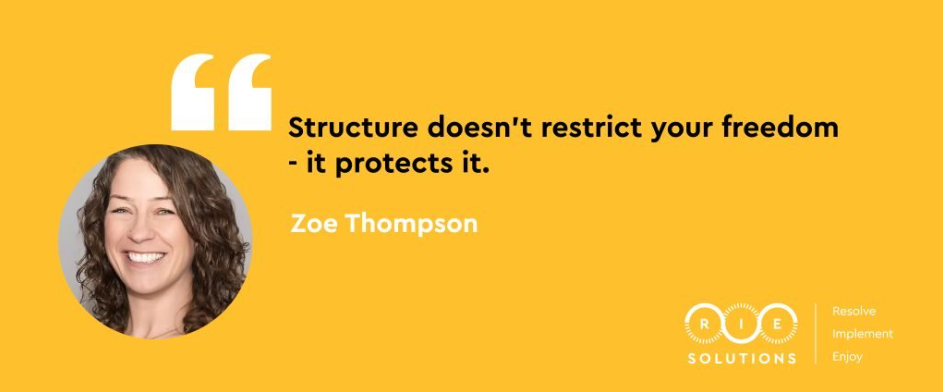
Structure is what makes success sustainable. Planning is an effective tool, if we don’t have a structure in place to support and enable its implementation, then we are setting ourselves up to fail. Humans need certainty and variety. A strong structure creates the certainty we crave, while leaving space for the variety we need. A good structure protects and preserves the priorities.
We’re creatures of habit, so a solid structure which allows for routines helps flow, and it can improve efficiency and effectiveness, reduce decision fatigue and procrastination.
Are your routines designed by default or by design?
Does your schedule reflect your priorities or your distractions?
Do you have clear boundaries in place to protect the structure?
Recommended Next Step: Build the boundaries, systems, and workflows that support strategic thinking, reduce decision fatigue, and keep your priorities protected.
Why This Matters More at a Senior Level
At a senior level, the stakes are higher. You are not just managing tasks, you’re managing energy, expectations, outcomes, and people.
You aren’t responsible for every action, but you’re accountable for the outcome.
That means how you show up matters more than ever.
You are in a ‘hands-off’ position.
You are leading from the front, providing support and guidance rather than direction and instruction.
Your capability and quality as a leader is no longer your ability to ‘do’. Your teams are now assessing your leadership on your ability to communicate, make decisions, and lead with confidence.
You are setting the tone for your team, your department, and your legacy.
And if you are constantly stuck in the weeds of the details, reacting instead of leading, or doubting your direction, the cost can be more than just your output.
The Real Problem Is Not You – It’s Misalignment
If you are out of alignment then it may feel like you are falling short, you may question your capability, the problem is not you or your ability, you are operating without integration. You have planning tools but no clear identity. You have mindset strategies but no structure to anchor them. You have ambition, but no system to hold it all together.
The PIIPS Framework isn’t a one-time solution. It’s an operating system. It’s how you reconnect your personal values with professional performance. And how you can stop sacrificing your time, energy, or health to hit goals that were never aligned to begin with.
Each part of the PIIPS Framework supports the others.
Miss one, and the system wobbles.
But when they work together, they create clarity, consistency, and momentum that feels natural, intentional, and sustainable.
This is how you stop firefighting.
This is how you stop second-guessing yourself.
This is how you lead yourself forward – with structure, confidence, and purpose.
The PIIPS Framework isn’t a one-time fix or something you tick off a list.
It’s a system you come back to again and again, to plan your week, refocus your goals, check in with your values, and move forward in alignment.
It grows with you, adapts with you, and helps you turn insight into action and action into progress.

One Final Thought
You already have the ambition. The expertise. The work ethic.
What you need is a framework that brings it all together, so that your success feels as good as it looks.
Because success without alignment feels like pressure.
But success with alignment?
That’s power.
That’s leadership.
That’s yours to claim.
The Secret to Aligned Success? – It’s Called PIIPS
Unlock Your Potential: The PIIPS Framework for Success


Comments